Second, congratulations to Quebec, but mostly Jean Charest. Thanks to Mr. Charest's excellent tactical skill, managing to turn a separatist up swell of support due to Harperian divisive politics, into a majority for a fiscally strong federalist party. If only he were federal. Also of note, in the strong Canadian history of vote splitting, (we had two right wing parties, we have three pro environment parties, and two communist parties... of all things) Quebec has re-affirmed itself as the source of the very word "Canada" by now having two elected separatist parties. How can you get more Canadian?
Third, in response to the earlier post on western alienation, I would like to make a few quick comments. While it is quite true that the coalition (even more so the Liberals) is weak in the west, the same can be said of the Conservatives in the east. I'll mention some ridings later, but the graph shown earlier, shows just how weak their eastern representation is, and many of their eastern ridings were very close. What is more, the Conservatives again failed miserably at making into the cores of the major cities. The 416, the exotic isle of Montreal, the Burrard Peninsula, all went left. That said, I hope that all three of the parties manage to find support from across the nation, as I don't think regionalism helps anyone.
I would also wanted to comment quickly the economics mentioned. First, as we are a federation, with equalization, and federal institutions, the economies of all of Canada should matter to everyone. Being from Atlantic Canada, I know how prosperity in one place can ease the downturn elsewhere. Further, though the west has been rather bullish of late on the economic stage, it should be noted that the four western provinces taken together have yet to catch up to the province of Ontario in terms of population or economy, and Quebec still handily beats any one of those provinces on a one on one.
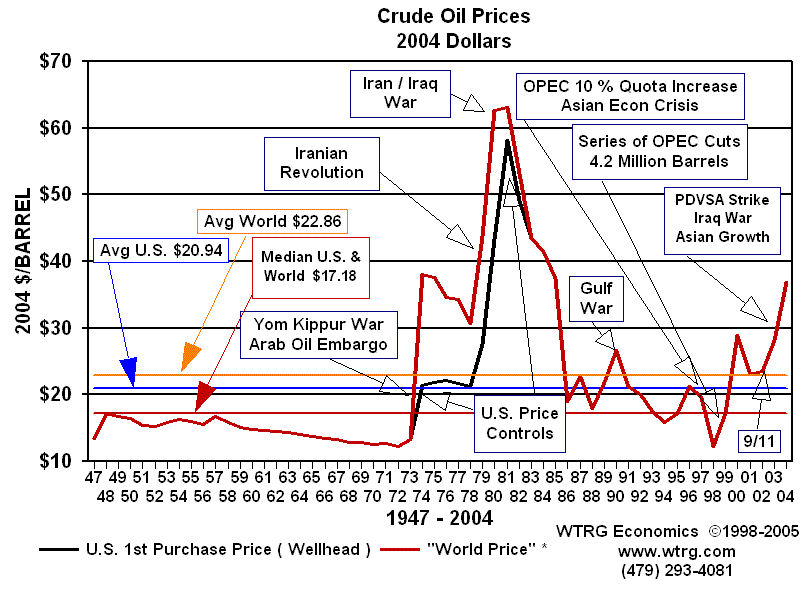
 The recent hardships of the manufacturing and auto sectors will likely accelerate the trend seen above (and below), but it should be noted that oil is at (recent) record lows, and though this is unlikely to persist as long as the oil slump in the 80s, it could put a damper on western growth (and the numbers shown before). Troubles with OPEC way even depress prices for longer, which is not a good sign for oil production based economies.
Lastly, on the note of regionalism, I want to make sure that the idea of a coalition (as with all other ideas Mr. Dion has touched) does not disappear just because Mr. Dion's less then in touch tactics have chosen a less then ideal time/method to have a good idea. Now, I'm not advocating a coup, and I'm not saying anything should be done. However, even if the NDP and the Liberals were to agree to stay out of each others battles with the Conservatives, the next election could be very different. For example, take Egmont, PEI. After what should have been considered illegal tactics, the Conservatives managed a 55 vote lead over the Liberals. With 1670 NDP and 626 Green voters in the riding, it doesn't take a genius to see the possibilities. Other ridings of note (from a quick perusal of the results) :
The "ever so close" for the Liberals:
- Kitchener-Waterloo
- Kitchener Centre
- Mississauga-Erindale
- Oak Ridges-Markham
- Saint John
- Egmont
- London West
- Kenora
- Essex
- Miramichi
- West Nova
- South Shore-St.Margaret's
- Saskatoon-Rosetown-Biggar
- Surrey North
The point is that with enough support moving from one party to the other, BC could turn Orange, and Ontario could turn Red. That doesn't even take into account an upswing in support with a different liberal leader, and any decreased confidence in Harper.
In the end however there are definite reasons why anything like this would be hard, if at all possible. I suspect one of the biggest is that even though Liberals and NDPers tend to fall on similar sides of the issues, they may not always do so for all of the same reasons. Some of the negative reaction to the coalition was likely due to this, though some would likely have been out of surprise, worry, and want for stability. Still, if they could make some simple "play nice" agreement, and sold it to Canadians they could get more seats for less bucks. The risk, of course, is that the Liberals would risk becoming a regional party, with no real claim to power. All of this, in the end is probably the best argument for STV.
So, while we definitely have our differences, I think we need to remember that 141 years ago, it was decided that we are stronger together (though to be fair, the Americans don't want to take our prairies from us in the same way as they used to). Even though we have had separatist movements from day 1, and from across the country, we have always realised the truth in this, over the long term. When some are weak, others are strong. Even though Atlantic Canada has been very "have not", Alberta would be in a larger labour bind without the healthy and educated work force that it provides. And who knows, if wind/water energy goes huge, maybe the reverse will happen someday. We need to look past regionalism to find Canadian solutions that work for the differing political views of this country. Then we need to look past those views to work together to actually move forward when we need to. (Like, maybe, now?)
I'm fairly confident we can do it. If there is anything we are good at, it is dealing with the issue enough so that it doesn't separate us, but we feel uncomfortable enough not to bring it up. And what is more Canadian then awkward silence?
Note:BC-STV is pretty good, as it keeps a good level of regional accountability, which is important for many Canadians. Though I can't say I'm a fan of multi-member ridings, my preference would be to simply have STV in all of our 1 member ridings. It should also be noted that Proportional Representation has been considered by 5 provinces. BC came close on STV, Ontario, and PEINB decided not to hold a referendum on MMPR, and Quebec is still considering. turned down MMPR handily (no regional accountability),


No comments:
Post a Comment